
When it comes to great American classic yachts, Marilee stands out for good reason. She is part of the New York 40 Class (NY40), a one-design class commissioned by the New York Yacht Club (N.Y.Y.C) and designed by Nathanael G. Herreshoff.
Built in Rhode Island in 1926 as Hull #955, Marilee was originally commissioned by Edward I. Cudahy, owner of the Cudahy Packing Company. She is not only an exceptionally beautiful and carefully restored yacht, but also a remarkable piece of American yachting history.
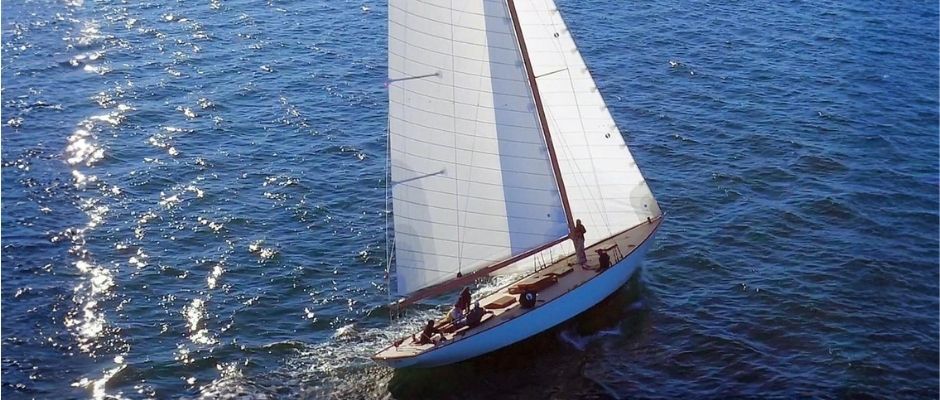
❐ Marilee, one of the last great New York 40s
1. The New York 40 Class – Its Origins
The story of the New York 40 begins in the years before the First World War. In the 1910s, the New York Yacht Club was looking for a new kind of yacht: one that could perform with authority on the racecourse, yet also offer the seaworthiness and comfort required for longer coastal cruising.
In 1915, the Club turned to Nathanael G. Herreshoff and commissioned a new one-design class. The ambition was clear: this was to be a yacht that combined competitive sailing with the substance and composure needed for life beyond the regatta course. The class rules were notable too. Each yacht was to be helmed by her owner, while the number of professional crew on board was strictly limited.
The first twelve boats of the class were launched in 1916. At first, the design did not win universal praise. For its time, the New York 40 appeared notably broad in form, with a comparatively high freeboard that set it apart from earlier Herreshoff racing classes. Yet what initially drew criticism soon proved itself on the water. The New York 40 went on to become one of the most distinctive American one-design classes of its era — shaped by that sense of proportion and quiet discipline which truly fine designs do not lose, even after a century.
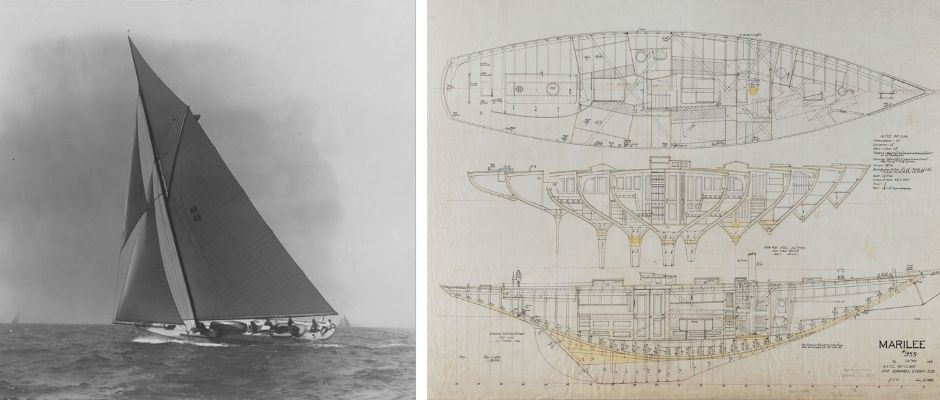
❐ Historic photograph and original plans of Marilee
2. Marilee – A Late Member of the New York 40 Class
After the first boats of the class had been built, the First World War brought further development to a halt, and regular racing did not resume until 1920. It was only in 1926 that two additional New York 40s were completed: Marilee and her sister yacht Rugosa II. Although both yachts shared the same hull lines, Marilee was given a newly designed coachroof, a distinctive interior layout and a larger cockpit — part of what gives her a special place within the class. She is unmistakably a New York 40, yet she also carries a character of her own.
The timing of her arrival is equally telling. Although the war was long over, economic conditions remained difficult, and the world of yachting was already turning towards smaller, more affordable boats. Marilee still took part in the 1926 season, but the class soon lost momentum. By 1927, much of the fleet had already changed hands.
The photograph below shows Marilee under construction in the North Construction Shop of the Herreshoff Manufacturing Company. In the background, schooner Mary Rose (#954) is visible; in the foreground, her sister yacht Rugosa II (#983) is being planked upside down.
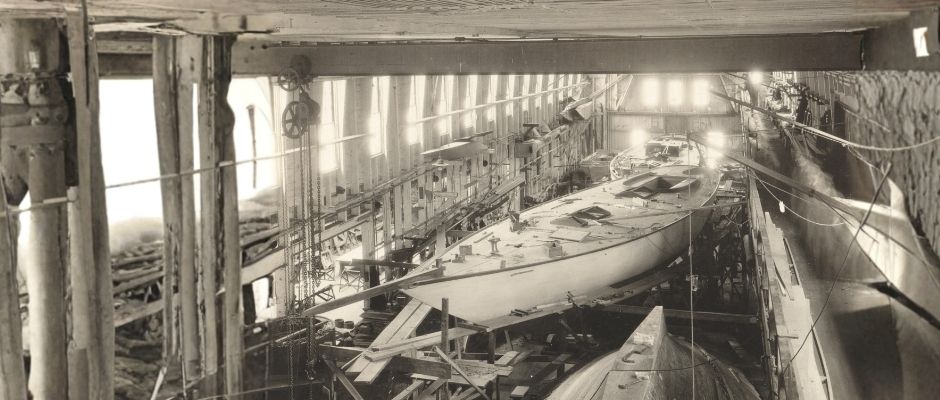
❐ Marilee under construction 1926
3. Nathanael G. Herreshoff – The Mind and Hand Behind the Design
Any account of the New York 40 — and of Marilee — leads back to Nathanael Greene Herreshoff. In the history of yacht design, his name still carries unusual weight. Known as the “Wizard of Bristol”, he shaped American yacht building in a way few others ever did. He was not only a gifted designer, but also an engineer with a remarkable sense of proportion, balance and purpose.
He is most closely associated with the America’s Cup. From Vigilant in 1893 to Resolute in 1920, e every successful American defender of that period came from his drawing board. Yet Herreshoff’s true importance lies beyond victory alone. What gives his work lasting significance is the discipline of his thinking: performance was never detached from beauty, and beauty was never allowed to exist without purpose.
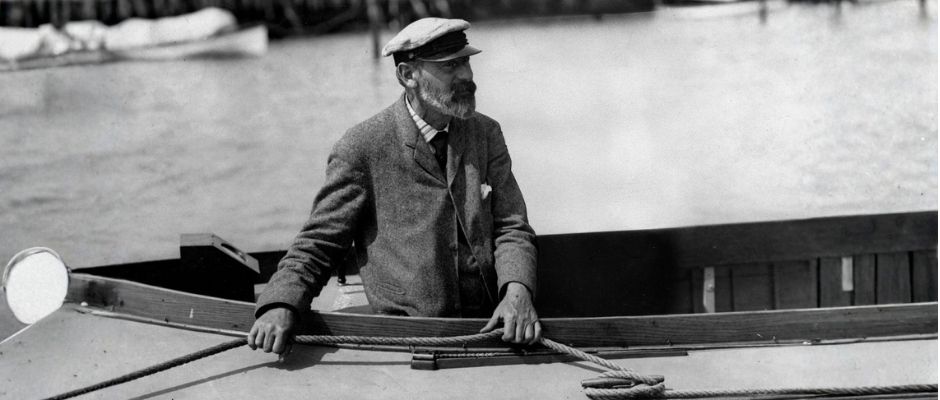
❐ Nathanael Greene Herreshoff
4. Why Marilee Still Matters Today
What gives Marilee her special place today is not only her age, her beauty or the name behind her design. It is the fact that she remains part of a living tradition. As one of the very few New York 40s still actively sailed, she stands for something rare in the world of classic yachts: not simply preservation, but continued life on the water.
That matters because Marilee is more than a restored survivor from another age. She shows that a yacht from the great period of American yacht design can still be experienced as it was meant to be — under sail. She is not merely admired or preserved. She lives on in use — something that has also been noted by Classic Boat in its coverage of her restoration.
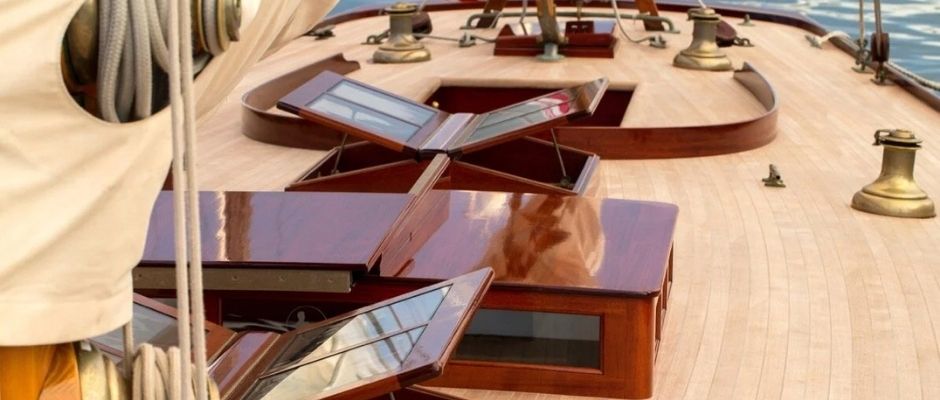
❐ Classic craftsmanship on board Marilee.
5. The Restoration – Preserving, Understanding, Rebuilding
One of the most remarkable parts of Marilee’s recent story is the care with which she was brought back. In Maine, she underwent a major restoration at French & Webb — what had first seemed likely to be a limited refit gradually became something far more extensive.
The hull was digitally measured and compared with the original Herreshoff plans in order to recover her lines with precision. As the work progressed, it became clear how far her hull and deck profile had drifted from their original form over the decades. The restoration was therefore not only a demanding exercise in craftsmanship, but also one of interpretation: how do you bring back a historic yacht without smoothing away her character?
As the project moved forward, important structural areas were renewed or strengthened — among them part of the keel, major floor timbers and the mast step. Yet what makes the restoration so compelling is not any single intervention, but the clarity of the approach behind it. This was never intended as a cosmetic exercise. It was about returning a historic racing yacht to a form true to her origins: structurally sound, faithful in character and ready to sail again.
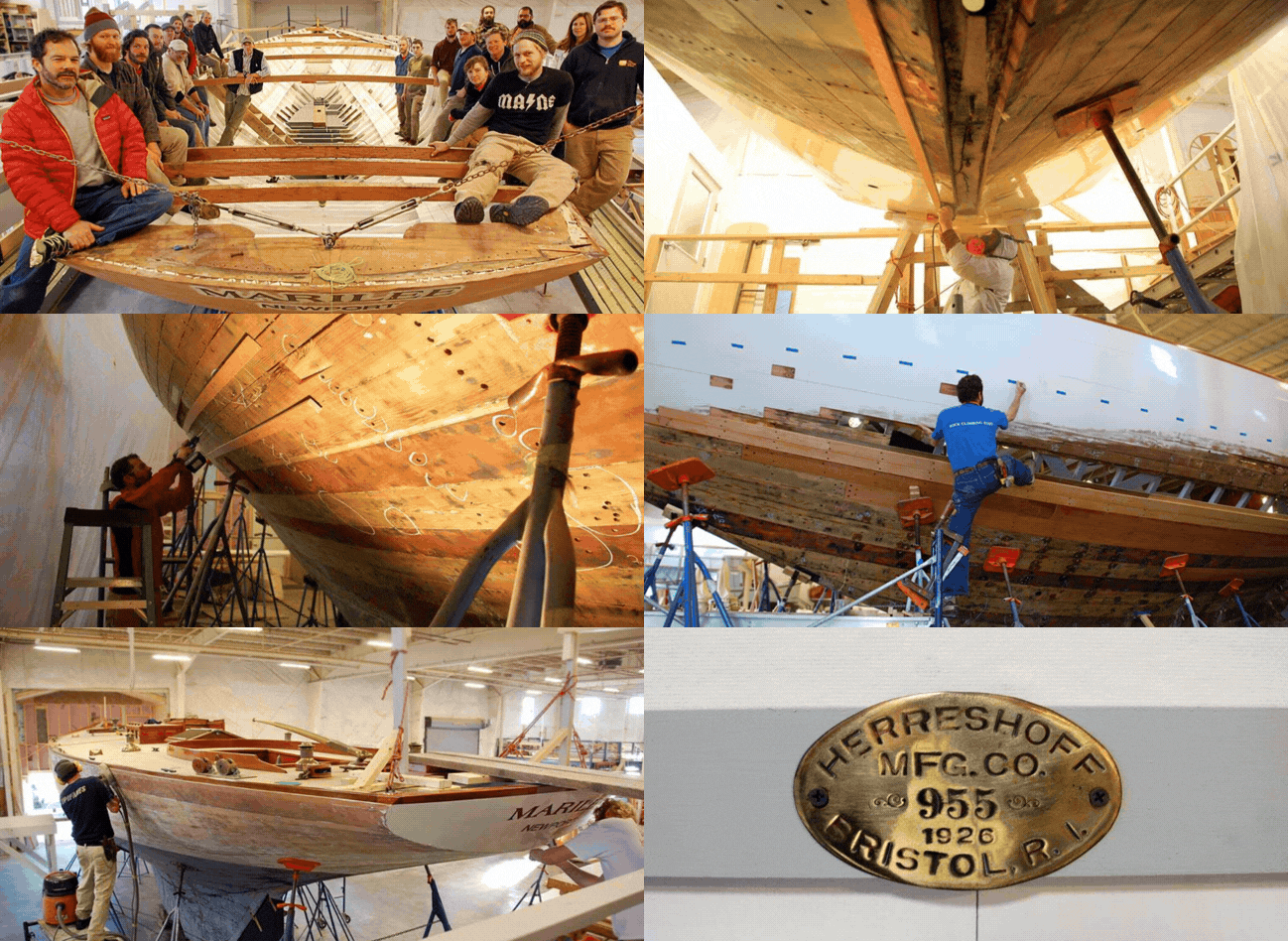
❐ Scenes from Marilee’s restoration at French & Webb
6. The Rediscovery of the Original Drawings
One of the most fascinating aspects of Marilee’s restoration was the resurfacing of original drawings during the process. Additional plans relating to the yacht were found in the MIT Hart Nautical Collections, among them a drawing for a Marconi rig (also known as a Bermuda rig) originally intended for a conversion in 1933. What made this discovery so significant was that it pointed not to some later outside modification, but to a further development drawn by Herreshoff himself.
This made it possible to prepare Marilee to be sailed with two different rig configurations. To achieve this, French & Webb introduced a series of carefully concealed structural solutions in the bow, stern and mast areas — the result being a yacht that is not only historically compelling, but technically unusual in a particularly elegant way. French & Webb documented the restoration process in a short film — a rare opportunity to see the craft and thinking behind the work at first hand.
7. Marilee – Her Sporting Achievements
Marilee is by no means a yacht that lives on reputation alone. In recent years, she has made a clear impression on the classic regatta circuit. In 2021, she won both the overall Vintage division and the Maine regional division of the Classic Yacht Challenge Series; in the same year, she also took first place in the Vintage division at the Herreshoff Classic Yacht Regatta.
A further notable result came in 2024, when she again secured overall victory in the Vintage division of the Classic Yacht Challenge Series, together with first place in the Maine region. These results speak for themselves. Marilee is not only admired as a restored classic — she continues to be taken seriously as a racing yacht.
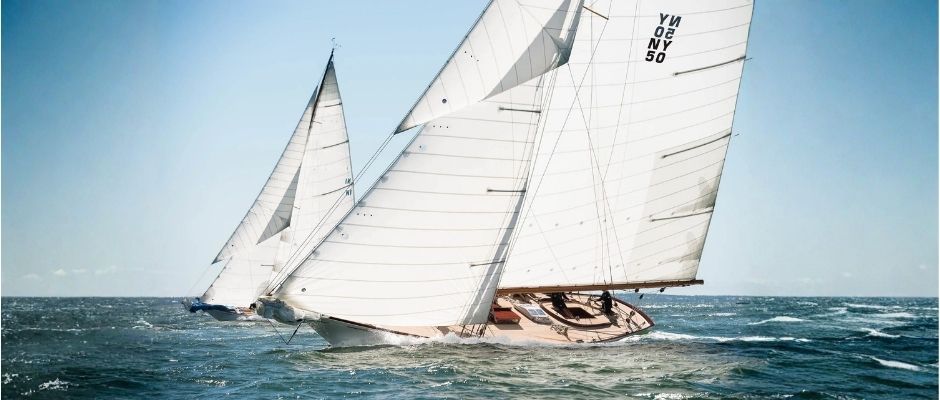
❐ Marilee on the racecourse
8. Why Marilee Still Matters
What gives Marilee her special presence today is not only her age, her beauty or the name behind her design. It is the fact that she remains part of a living tradition. She is one of only four New York 40s still actively sailed — a rare distinction that says far more than any technical note ever could. A design from the great age of American yacht building has not merely been preserved; it continues to be tested, understood and appreciated in the element for which it was created.
That is what makes Marilee feel like so much more than a restored classic. She is not held at a distance, admired only as an object of the past. She remains a yacht in use — and with that comes a different kind of authority: quieter, perhaps, but more convincing.
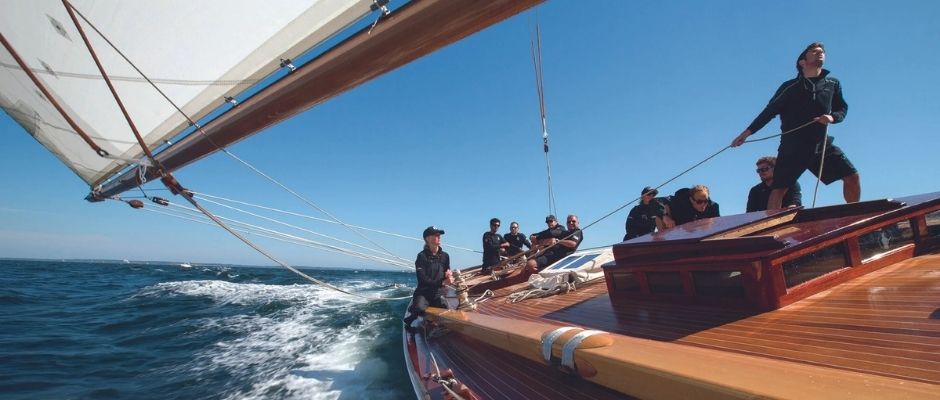
❐ Marilee in motion, crew in rhythm
At Noblesse Yachts®, we are dedicated to preserving the relics of maritime history. We achieve this by bringing their stories to life for people today—viewing them as windows into the past. Our efforts include documenting their evolving roles through time, highlighting their battles for survival, and showcasing the dedicated individuals who have committed themselves to preserving these floating treasures, often at great personal risk. Adi Konstatzky, CEO and founder of Noblesse Yachts, speaks from experience. He has personally contributed to the preservation of two classic vessels: a steamship from 1913 and a motorship from 1928.
Note about copyright: This text is copyrighted by us, and you may copy and use it only with a link to our website along with a clear indication of our authorship. Thank you!
#Marilee #Herreshoff #NewYork40 #ClassicYacht #HistoricYacht #YachtingHistory #YachtRestoration #MaritimeHeritage #ClassicSailing #NavalArchitecture #RacingYacht #LegendaryYachts #worldofevents #AdiKonstatzky #hohentwiel1913 #oesterreich1928